
Gymnopedies No.1 & Chopin Nocturn Op.9 Nr.1 / Gymnopedie No.1 & Chopin Nocturn Op.9 Nr.1
Hanna
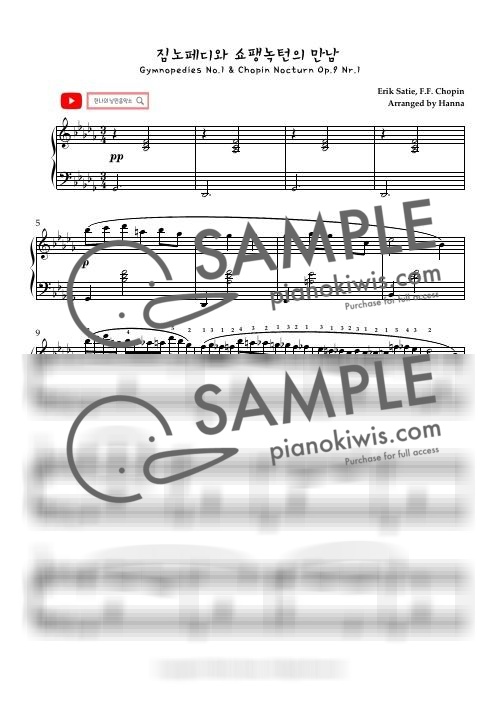
1/4
You are using the demo web viewer. Download the app for a better experience.

hanna_piano
Sheet Length
88Measures (4Pages)
Key Signature
5
Special Features
Key Range
61Key
76Key
88Key
Difficulty
Intermediate
Registered
9/10/2024
Updated
7/8/2025
Wish
 Open in app
Share
Inquiry
Score Description
A Meeting of Two Classics!
Erik Satie Gymnopédie + Chopin Nocturne Op.9 Nr.1
4p.
Difficulty : Hard
[ Song Description ]
『Gymnopédie Meets Chopin Nocturne』
Gymnopedie No.1 & Chopin Nocturn Op.9 Nr.1
The piece I'm introducing this time is a newly created work born from the meeting of Erik Satie's Gymnopédie No.1 and Chopin's Nocturne Op.9 Nr.1.
The original Chopin Nocturne is in minor. However, in this arrangement, it begins in major.
First, in the intro, the accompaniment part of Erik Satie's Gymnopédie No.1 is played with chords in Db key, which differs from the original.
Then, the melody of Chopin's Nocturne Op.9 Nr.1 flows in.
The left-hand accompaniment is also built on the same Gymnopédie No.1 accompaniment as the motif.
Of course, the chord progression of the accompaniment differs from the original since it's matched to Chopin's melody,
but the flow and feel are kept similar as it progresses.
Gradually, it begins to flow more like Chopin, and the mood of the melody and accompaniment
also shows some jazz-harmonic elements and rhythms slightly different from the original.
In this arrangement, I didn't use the entirety of Chopin's original melody.
I thought carefully about whether it would really be good for the audience
to stubbornly stick to connecting every single part of both Satie's and Chopin's melodies all the way through in the same flow,
and as a result, I chose to use only the portion of the melody that even people unfamiliar with these pieces could hum along to, right up to the end.
So, the beginning part of Chopin's Nocturne became the main motif, and the piece unfolds in a variation form from there.
As with my other classical arrangements, the latter half is expressed with a jazz ballad feel.
The backdrop of Gymnopédie is water.
I composed this piece while imagining a scene where someone falls asleep for a moment listening to Gymnopédie by a lakeside,
has 'a dream where Chopin's melody appears,'
and then wakes up again as Gymnopédie comes to a close.
This is the 4th piece I'm introducing under the theme 'A Meeting of Two Classics!'
What I always feel while arranging classical pieces is admiration for the fact that the lines and moods we use today
were already created back in that era, along with a sense of awe at their solid and outstanding structures.
So I approach each piece with even more care and humility.
I hope this brings a bit of coolness and comfort to your hearts on this beautiful autumn night.
Arrangement: Hanna
hanna_piano
Other scores by this creator


