
Moonlight Sonata Meets Chopin's Nocturne / Intermediate
Hanna
1/5
You are using the demo web viewer. Download the app for a better experience.

hanna_piano
Sheet Length
65Measures (5Pages)
Key Signature
4
Special Features
KiwiHands
Key Range
61Key
76Key
88Key
Difficulty
Intermediate
Intermediate-Level Scores (Easier than the Original)
Registered
8/22/2024
Updated
7/8/2025
Wish
 Open in app
Share
Inquiry
1.Right-Hand Practice
This sheet music is a 6-part course.
Start learning with KiwiHands!
Start learning with KiwiHands!
Score Description
Classic, Romantic, and Modern Series
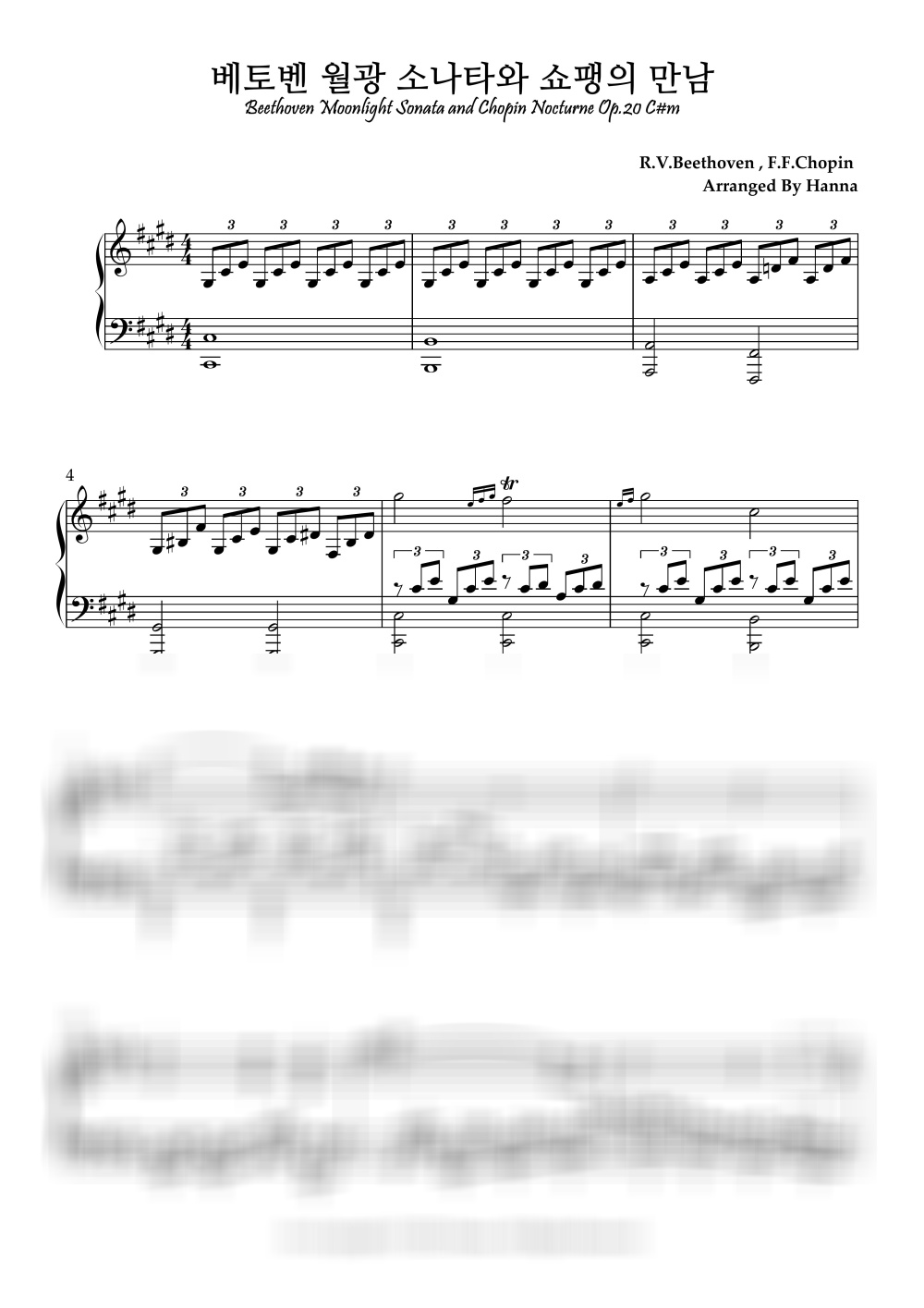
Beethoven Moonlight Sonata and Chopin Nocturne Op.20 C#m
Subtitle: The Meeting of Beethoven's Moonlight Sonata and Chopin's Nocturne
Song Description)
Beethoven's Moonlight Sonata, composed by a Classical composer, is actually a Romantic piece rather different from the typical Classical sonata form.
Its original title was "Quasi una fantasia," and it was later named "Moonlight Sonata" by a critic.
This piece was dedicated to his student Giulietta Guicciardi, with whom Beethoven had briefly fallen in love.
The first movement of this piece is in 2/2 time, featuring a continuous pattern where the right hand plays triplet arpeggios above the left hand's octaves.
In "The Meeting of Beethoven's Moonlight Sonata and Chopin's Nocturne," the atmosphere and repeated pattern of the Moonlight Sonata's 1st movement are mainly played in the left hand, giving the overall mood to the piece.
The theme section of the Moonlight Sonata's 1st movement is played as an introduction, followed by the melody of Chopin's Nocturne.
"Chopin Nocturne Op.20 in C#m" was composed by Chopin at the age of twenty, after he left his homeland and arrived in Vienna.
It is said to express his longing for his homeland. He dedicated this piece to his sister, Ludwika Chopin, and it was published after Chopin passed away.
This piece gained even greater popularity as the OST for director Roman Polanski's film "The Pianist," which exposed the horrors of war.
Not only does it share the same key as the Moonlight Sonata, but the two pieces also share similar themes and emotions of separation — whether from a loved one or from one's homeland — which is why I decided to arrange them together as a connected piece.
Reconstructing and arranging the perfect works of great masters is no small burden.
But the joy of witnessing two beautiful pieces come together to create a new piece with a fresh feeling is beyond words.
I think that's why I keep persisting with such large-scale projects.
I also worked on adding modern harmonic elements and other elements to make it easier for contemporary listeners to approach classical music.
I hope many of you will enjoy performing "The Meeting of Beethoven's Moonlight Sonata and Chopin's Nocturne."
:: Credit
"The Meeting of Beethoven's Moonlight Sonata and Chopin's Nocturne"
Composed by: R.V.Beethoven, F.F.Chopin
Arrangement: Hannah
Piano: Hannah
* You can also listen to this on various music streaming sites.
Beethoven Moonlight Sonata and Chopin Nocturne Op.20 C#m
Subtitle: The Meeting of Beethoven's Moonlight Sonata and Chopin's Nocturne
Song Description)
Beethoven's Moonlight Sonata, composed by a Classical composer, is actually a Romantic piece rather different from the typical Classical sonata form.
Its original title was "Quasi una fantasia," and it was later named "Moonlight Sonata" by a critic.
This piece was dedicated to his student Giulietta Guicciardi, with whom Beethoven had briefly fallen in love.
The first movement of this piece is in 2/2 time, featuring a continuous pattern where the right hand plays triplet arpeggios above the left hand's octaves.
In "The Meeting of Beethoven's Moonlight Sonata and Chopin's Nocturne," the atmosphere and repeated pattern of the Moonlight Sonata's 1st movement are mainly played in the left hand, giving the overall mood to the piece.
The theme section of the Moonlight Sonata's 1st movement is played as an introduction, followed by the melody of Chopin's Nocturne.
"Chopin Nocturne Op.20 in C#m" was composed by Chopin at the age of twenty, after he left his homeland and arrived in Vienna.
It is said to express his longing for his homeland. He dedicated this piece to his sister, Ludwika Chopin, and it was published after Chopin passed away.
This piece gained even greater popularity as the OST for director Roman Polanski's film "The Pianist," which exposed the horrors of war.
Not only does it share the same key as the Moonlight Sonata, but the two pieces also share similar themes and emotions of separation — whether from a loved one or from one's homeland — which is why I decided to arrange them together as a connected piece.
Reconstructing and arranging the perfect works of great masters is no small burden.
But the joy of witnessing two beautiful pieces come together to create a new piece with a fresh feeling is beyond words.
I think that's why I keep persisting with such large-scale projects.
I also worked on adding modern harmonic elements and other elements to make it easier for contemporary listeners to approach classical music.
I hope many of you will enjoy performing "The Meeting of Beethoven's Moonlight Sonata and Chopin's Nocturne."
:: Credit
"The Meeting of Beethoven's Moonlight Sonata and Chopin's Nocturne"
Composed by: R.V.Beethoven, F.F.Chopin
Arrangement: Hannah
Piano: Hannah
* You can also listen to this on various music streaming sites.
hanna_piano
Other scores by this creator


